|
Conventional Starter
|
Other Constructions of Starter
|
|
|
| 4. |
Brake mechanism
|
| (1) |
General
|
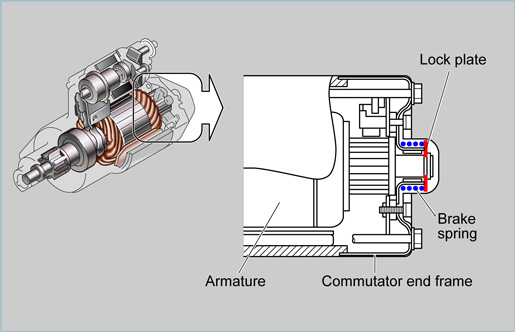
| Most conventional type starters are equipped with a brake mechanism, which stops the rotation of the armature once the engine starts. The brake mechanism also acts to control the speed of the armature immediately after the engine starts |
REFERENCE:
A Most reduction type starters do not have a brake mechanism for the following reasons:
 |
The armature is much smaller and lighter than a conventional starter and the inertia force is low. . |
|
The pressure of the brush springs acts to control the speed of the armature |
|
The reduction gear mechanism also causes friction. |
| However, there are some large-sized starters (24V-type) which are equipped with an electrical brake mechanism. |
| (2) |
Operation
|
| The brake spring and lock plate force the armature against the commutator end frame to produce a braking effect. |
|
|
(23)
|
|