|
|
| 1. |
Characteristics of DC (Direct Current) series motors
|
| (1) |
Relationship between starter speed, torque and current
|
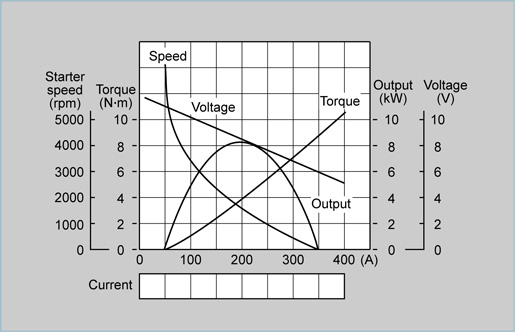
A circuit of a motor basically consists of only coils. The resistance value inside the circuit is very small because only the resistance value of the coil exists in the circuit. According to Ohm's law, the current value will be large if the battery voltage (12 V) is constant and the resistance value is small. Therefore, a large amount of current flows to the starter, and maximum torque is produced just after the starter begins to rotate.
Since a motor and a generator have similar construction, reverse direction voltage (counter-electromotive force) is generated when the motor revolves, impeding the current flowing through the starter motor.
Since the counter-electromotive force become larger as the starter rotational speed increases, the current flowing through the motor decreases, as does the torque.
REFERENCE:
 |
The gear ratio of the ring gear and the starter pinion gear is approx. 1:10 to 1:15. |
|
Output is low immediately after the starter begins to rotate because while the torque is large, the starter speed is low. The output increases to the maximum output point in accordance with the change in torque and starter rotational speed, and then it decreases as shown in the curved (output) line in the graphic. |
|
| (2) |
Relationship between current and voltage
|
|
|