| 3. |
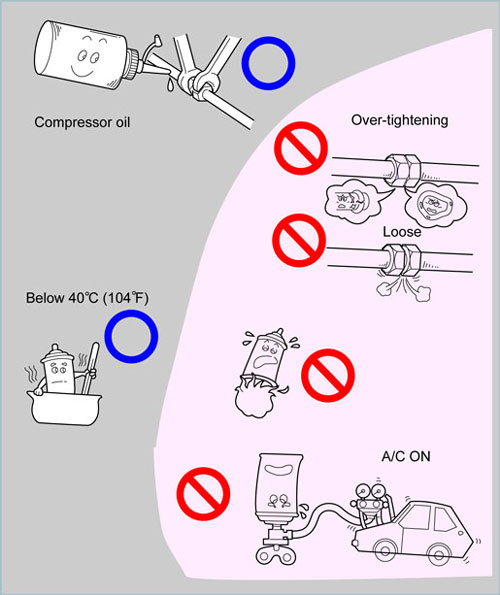
When tightening connecting parts
|
 |
Apply a few drops of compressor oil to all O-rings to prevent leakage of the refrigerant gas. |
|
First tighten all the nut using two open-end wrenches to avoid twisting the pipes/tubes. . |
|
Finally tighten the O-ring fittings or the bolted type fittings to specification using a torque wrench |
|
| 4. |
When handling bulk refrigerant |
|
The container must never be heated. |
|
Containers must be kept below 40°C. |
|
| 5. |
When A/C is on and refrigerant gas is being replenished
|
|
If there is not enough refrigerant in the refrigeration circuit, lubrication may become insufficient and the compressor may be damaged. |
|
If the high-pressure side manifold gauge valve is opened, a reverse flow of refrigerant will occur possibly causing the bulk refrigerant container to rupture, so only operate the low-pressure side manifold gauge valve. |
|
If the bulk refrigerant container is inverted and refrigerant is charged in a liquid state into the low-pressure side, the liquid refrigerant will enter the compressor and damage it, so the refrigerant must be charged in a gaseous state. |
|
Be careful not to over charge the refrigerant as this can cause trouble such as inadequate cooling, poor fuel economy and engine overheating. |
|